

Poultry House Design: Structure, Ventilation & Layout Guide
KXD Steel Technical & Project Team | Qingdao KXD Steel Structure Co., Ltd. | Published: 16 November 2026 | Last updated: 16 November 2026
Good poultry house design usually starts with the structure: a frame with a clear span, a roof pitched for drainage, an insulated and sealed envelope, and surfaces that can be washed down. Each choice affects how well fans and inlets move air and how easily disease is kept out.
What a poultry house has to do
A poultry house is a machine for holding a stable climate around live animals. It keeps heat, moisture and ammonia from building up, keeps rain and wild birds out, and lets one crew feed, water, collect manure and clean without carrying disease from one flock to the next.
Most guides on this subject start from siting and bird space. Compared with those extension-style guides, this one starts from the building itself, because the structure fixes what the ventilation and biosecurity systems can achieve later. A fan cannot fix a leaking envelope, and a biosecurity plan cannot clean a surface that was never washable.
The table links each structural choice to its effect. The last column shows whether KXD publishes the value for its poultry house.
| Structural choice | Effect on ventilation | Effect on biosecurity | Published for the KXD poultry house? |
| Frame material and span | Clear span leaves room for long, unobstructed air paths and equipment lines | Fewer columns means fewer places for dust and droppings to collect | Not published |
| Roof slope | Sets drainage, and where ridge or gable openings can sit | Sheds water away from walls and entrances | Not published |
| Cladding and insulation | Limits temperature swings; an airtight skin lets fans pull air through the inlets you planned | A smooth, sealed lining keeps rodents and insects out and washes clean | Not published |
| Slatted floor | Lets droppings fall away from the bird zone, which affects air quality at bird level | Separates birds from manure | Published (slat size, hole options, life) |
| Environmental-control systems | Fans, cooling and controllers do the active work | Allows a closed house with controlled entry | Listed as available, no specifications |
The structure of a good chicken house
Frame and span
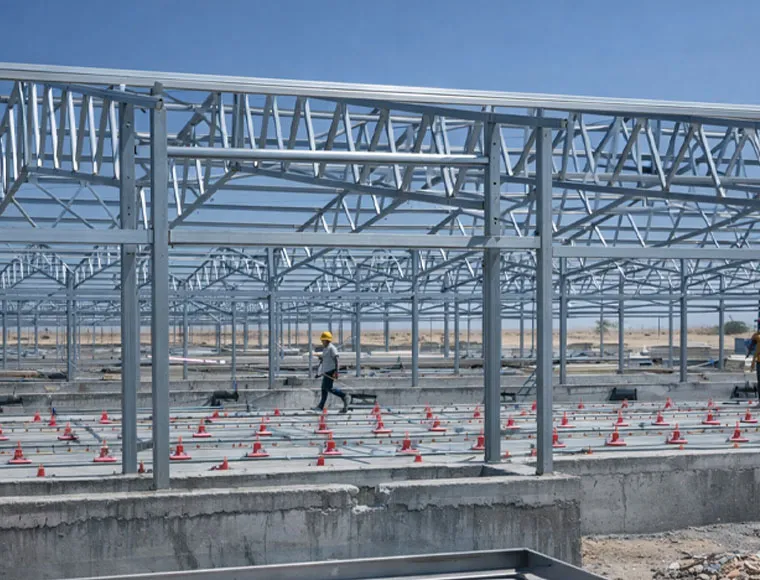
Steel is the usual choice when a house needs a wide, column-free interior, since the frame can carry the roof across the full width. That matters because feeding lines, drinker lines and manure removal run the length of the house and are easier to lay out without columns in the way.
KXD’s general Steel Structure Building line lists Q235B or Q355B welded H-section frames, single clear spans up to 100 m and wind resistance up to 160 km/h, customizable. Those values belong to that product line. The poultry house listing does not say which of them apply, so ask for the frame material, span and design wind load of the exact house you are buying.
Steel also has a cost that wood and masonry do not share in the same way. Bare steel conducts heat quickly, and the ammonia and humidity inside an occupied house are hard on coatings. The frame needs a protective coating, and the insulation has to be continuous so the steel does not turn into a heat path. Coating type and thickness are not published for the KXD poultry house.
Roof slope and openings
The same general line lists roof slopes from 1:10 to 1:5. For a poultry house, slope decides how fast rain leaves the roof, how snow slides off, and where ridge vents or gable openings can be placed.
A flatter roof is easier to build; a steeper one sheds weather faster and leaves more roof volume above the birds. Neither is correct without the site’s rain, snow and wind data, which is why a catalogue slope should be replaced by a site-based drawing.
Cladding and insulation
KXD’s larger steel buildings list single-skin steel, EPS, PU, rock wool and glass wool cladding, and its steel shed and warehouse pages list sandwich panels from 50 to 150 mm. The poultry house listing does not state which skin or panel it uses.
The choice matters in two directions. A single skin is cheaper and quick to build, but the interior follows the outside temperature closely and condensation forms on the cold side in cool weather. An insulated sandwich panel steadies the interior and gives a smooth inner face that is easier to wash. Insulation only pays off if the joints are sealed: air that leaks through gaps bypasses the inlets, and the ventilation system stops moving air where you planned it.
Foam cores such as EPS are combustible, and mineral wool is not. In a building that holds thousands of birds and has electrical equipment running day and night, ask for the fire rating of the panel in writing and ask which cores can be quoted.
Slatted floor
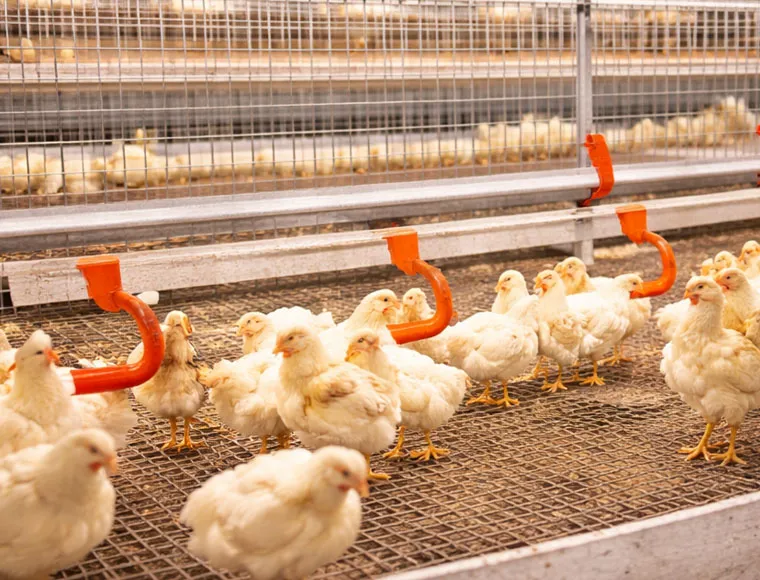
KXD lists an optional slatted floor made of 1,200 × 500 × 40 mm slats, with hole options of 16 × 16 mm or 20 × 26 mm and a listed slat service life of more than 10 years. A slatted floor keeps birds above their droppings, which helps air quality at bird level and reduces contact with manure.
The listing does not say which hole size suits which bird type or age, or how the slats are supported and secured. That decision depends on the species and the management system, so ask the supplier for a recommendation per bird type before ordering.
Ventilation follows from the structure
KXD lists feeding, nipple drinking, manure removal, cooling, ventilation, lighting and environmental-control systems as available for the house. No fan capacity, inlet area, cooling-pad size or controller model is published.
Ventilation has three jobs: remove stale air, remove heat and remove moisture. The building shape decides where air can enter and leave. A house with a long, sealed envelope and a defined set of inlets and exhaust points can be controlled; a house with random gaps cannot. When you compare quotations, compare the envelope and the ventilation package together, because a strong fan set inside a leaky shell wastes power.
Biosecurity built into the building
Biosecurity is often written as a protocol, but part of it is hardware. The structure can supply a sealed skin against wild birds and rodents, washable inner surfaces, floors and drainage that let a house be cleaned and dried, and a defined entry point where footwear and clothing change. The KXD listing does not describe doors, anterooms, bird-proofing or drainage details, so they have to be specified in the drawing.
KXDF-01 at a glance
The table shows what KXD has published for its Steel Structure Poultry House.
| Item | Published value |
| Product | Steel Structure Poultry House |
| Model as currently listed | KXDF-01 |
| Poultry applications | Broilers, layers, breeders and other poultry |
| Reference capacity | 10,000 to 50,000 birds per house |
| Optional slatted floor | 1,200 × 500 × 40 mm |
| Slat hole options | 16 × 16 mm or 20 × 26 mm |
| Listed slat service life | More than 10 years |
| Systems available | Feeding, nipple drinking, manure removal, cooling, ventilation, lighting, environmental control |
| Minimum order | 600 m² |
| Certification on product table | ISO |
| Published price range | USD 40 to 100 per m², depending on specifications |
The reference capacity is a range, not a design target. The listing does not tie it to a floor area or bird type, so a house for 10,000 birds and a house for 50,000 birds are different buildings and need different drawings.
Not published for this house at the time of writing:
- Frame material, span, eave height and roof slope
- Design wind load and snow load
- Wall and roof cladding type and thickness
- Insulation values and fire rating
- Coating type and thickness
- Fan, inlet and cooling specifications
- Floor area per configuration and per bird type
- Door, window and bird-proofing details
- Slat support and installation method
- Foundation requirements
Cost: what the published range does and does not say
KXD publishes USD 40 to 100 per m² for this house, depending on specifications. It does not state what the range includes, so confirm whether it covers the frame only or also cladding, slatted floor and equipment systems. Anything beyond the building, such as foundation, erection labor and utility connections, needs its own budget. Price moves with:
- cladding type and insulation thickness
- how much of the equipment package is included
- slatted floor or solid floor
- house size against the 600 m² minimum
- destination and freight
What certificates cover
KXD lists ISO 9001, ISO 14001 and ISO 45001 among its company credentials, and ISO appears on the poultry house product table. ISO identifies ISO 9001 as its quality-management-system standard, ISO 14001 as its environmental-management-system standard and ISO 45001 as its occupational health and safety management-system standard (source: ISO).
Those standards describe how a company manages quality, environmental impact and workplace safety. They do not state how a house ventilates, how well it insulates, or whether it meets a poultry welfare or building code in your country. Ask separately for the documents your local authority or integrator requires.
Design mistakes that show up late
- Treating capacity as the starting point. Choosing the bird count first and fitting the building around it reverses the logic. The ventilation and floor area need to be checked against the bird type before the number is fixed.
- Buying insulation without airtightness. Thick panels with leaking joints behave like thin panels with gaps.
- Ignoring coatings in a wet, ammonia-rich interior. The frame’s life depends on its coating, and the listing publishes no coating data.
- Choosing slat holes by catalogue only. The hole option that suits one bird type or age may not suit another.
- Leaving biosecurity to the protocol. If the drawing has no defined entry, no sealed skin and no washable surfaces, the protocol has to work harder.
Seven steps from brief to drawing
- Define the birds and the system. State species, production type (broiler, layer or breeder), growing cycle and whether the floor is slatted or solid.
- Fix the climate envelope. Record the site’s temperature range, humidity, rain, snow and design wind speed.
- Ask local rules first. Confirm bird-space requirements, building and environmental permits, and any welfare scheme the farm must follow.
- Choose the structure. Request frame material, span, eave height, roof slope and coating for the exact house.
- Choose the envelope. Specify cladding, insulation thickness and core, and ask how joints are sealed.
- Design the airflow. Ask the supplier to show inlet and exhaust positions, fan and cooling equipment, and the controller on the drawing.
- Add the biosecurity layer. Mark the entry point, bird-proofing, drainage and washable surfaces, then compare quotations on the same written specification.
FAQ
What is the structure of a good chicken house?
It usually has a steel or other frame that gives a clear interior, a roof pitched for drainage, an insulated and sealed envelope, washable surfaces, and a floor and drainage plan that keeps birds away from manure. The exact values depend on the species, climate and local rules.
How many birds can a KXD poultry house hold?
KXD lists a reference capacity of 10,000 to 50,000 birds per house. The listing does not tie that range to a floor area or bird type.
What are the slatted floor options?
The optional slats are 1,200 × 500 × 40 mm, with 16 × 16 mm or 20 × 26 mm holes and a listed service life of more than 10 years. Ask which hole size suits your bird type.
What is the minimum order?
600 m².
How much does a steel structure poultry house cost?
KXD publishes a range of USD 40 to 100 per m², depending on specifications. Confirm what the range includes before comparing quotations.
Does insulation matter in a poultry house?
Yes, because it steadies the interior temperature and reduces condensation, but it only helps when joints are sealed. The cladding and insulation of the KXD house are not published, so request them.
Can the house be fitted with ventilation and cooling?
KXD lists cooling, ventilation, lighting and environmental-control systems as available. No equipment specifications are published, so specify them in the quotation.